Boundary Arbitrage
October 6, 2026Who captures the value as the models get better?
Second in a series. Part 1 sorted which work companies keep buying from outside firms - helpful, not required.
Nobody used to buy demand letters.
The demand letter, the document that opens a personal-injury settlement negotiation, was a key work product that law firms kept in-house. A paralegal dug through hundreds of pages of medical records, billing statements, and low-quality scanned faxes. From that pile they pulled every date of service, provider name, and billing code, and flagged any gaps in treatment or missing records. Then they totaled the damages - medical bills, lost wages, reduction in earning capacity, pain and suffering - all without overlooking a single detail. A lawyer turned the facts of the case into a story, and the story into a demand for fair compensation for their client. Nobody bought this from a vendor, because nobody outside the firm could produce it at a market-clearing price while meeting the quality and accuracy bar a law firm requires. Then LLMs arrived, and EvenUp saw the opening.
I ran finance at EvenUp as we scaled from Series A to Series E and a $2 billion valuation. To our customers, the product was beautifully simple: hand us the case file, get back the finished letter, at or above the quality of your best paralegal’s work. All the complexity underneath - retrieving records, dozens of hours of document review, calculating damages, the nuances of every state and venue - abstracted away behind a flat price for a completed work product.
Demand letters were the perfect wedge into the personal-injury firm. Nearly every case needs one, and getting them out the door is often what holds up the settlement check. In this industry it’s not uncommon for a case to sit for months with every record in hand, waiting on nothing but the letter. Once we started selling, it was clear we had product-market fit. We found it by taking work that had always lived inside the law firm and moving it out, to a vendor - because for a moment, one vendor could deliver it dramatically better and cheaper than the firms could themselves. That’s the boundary of the firm moving, but in the opposite direction from the one I wrote about in Part 1, which was about outsourced work moving in-house.
Behind the simple product sat a lot of machinery: data pipelines, AI engineering, prompt engineering, and every trick we could find to get the most out of the OpenAI API. This was back in 2023 (a very long time in AI years) - there were no agents, no reasoning models, and everyone was wrestling raw APIs to get anything useful out at all. And no matter how much we put into it, the models alone couldn’t get close to the accuracy a law firm requires.
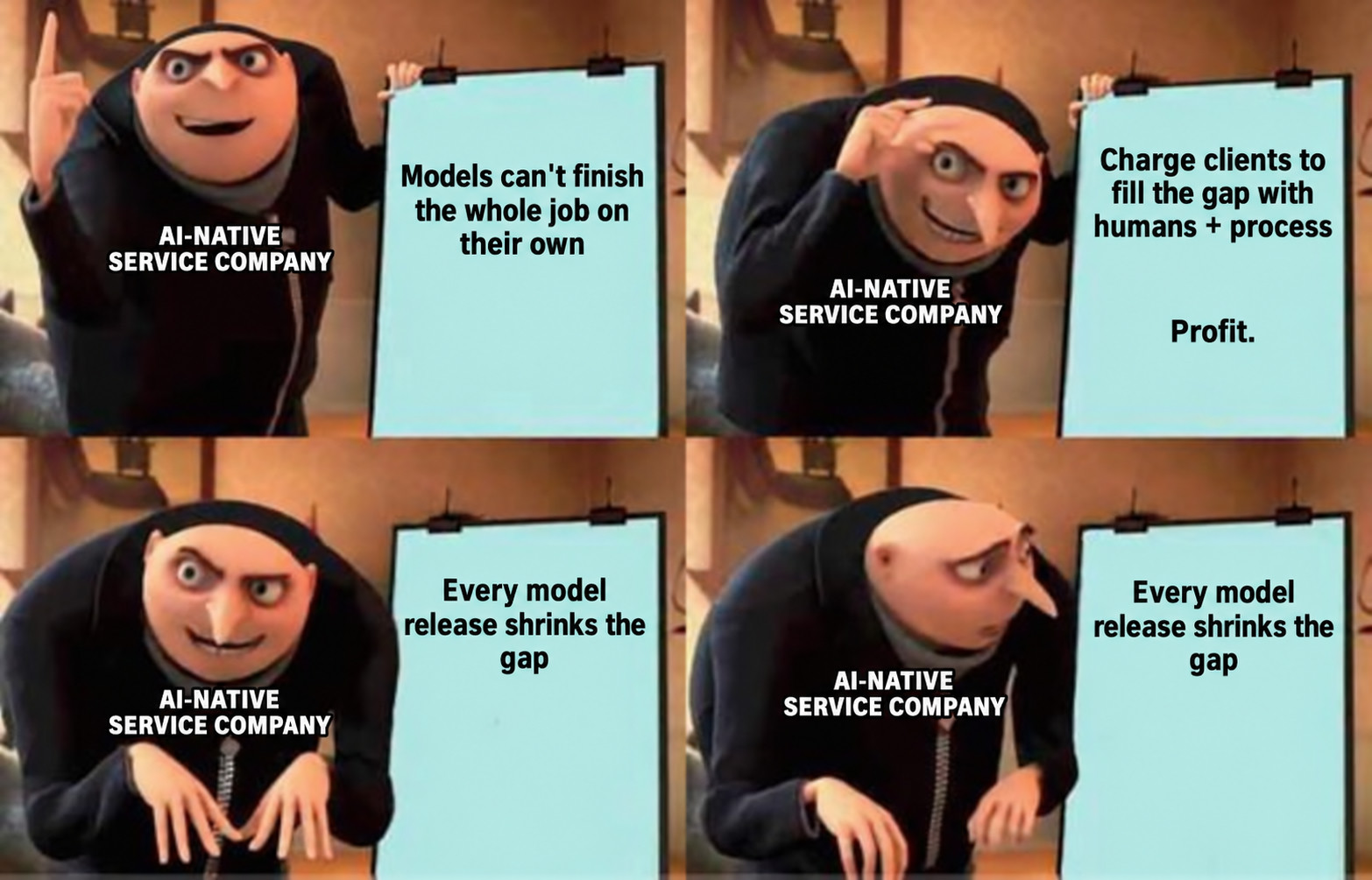
We filled the distance between what the models could do and a finished letter with paralegals, process, and measurement. Our engineering and product teams tracked where people spent their time and chipped away at the biggest blocks: extraction first, pulling the dates and providers a paralegal once dug for by hand; then summaries that gave the writer a head start; eventually full drafts, with humans checking instead of writing. Exploiting the gap between model capability and a finished product was EvenUp’s arbitrage. We closed that gap with a mix of product and labor, and built one of the first AI-native services firms before the category even had a name.
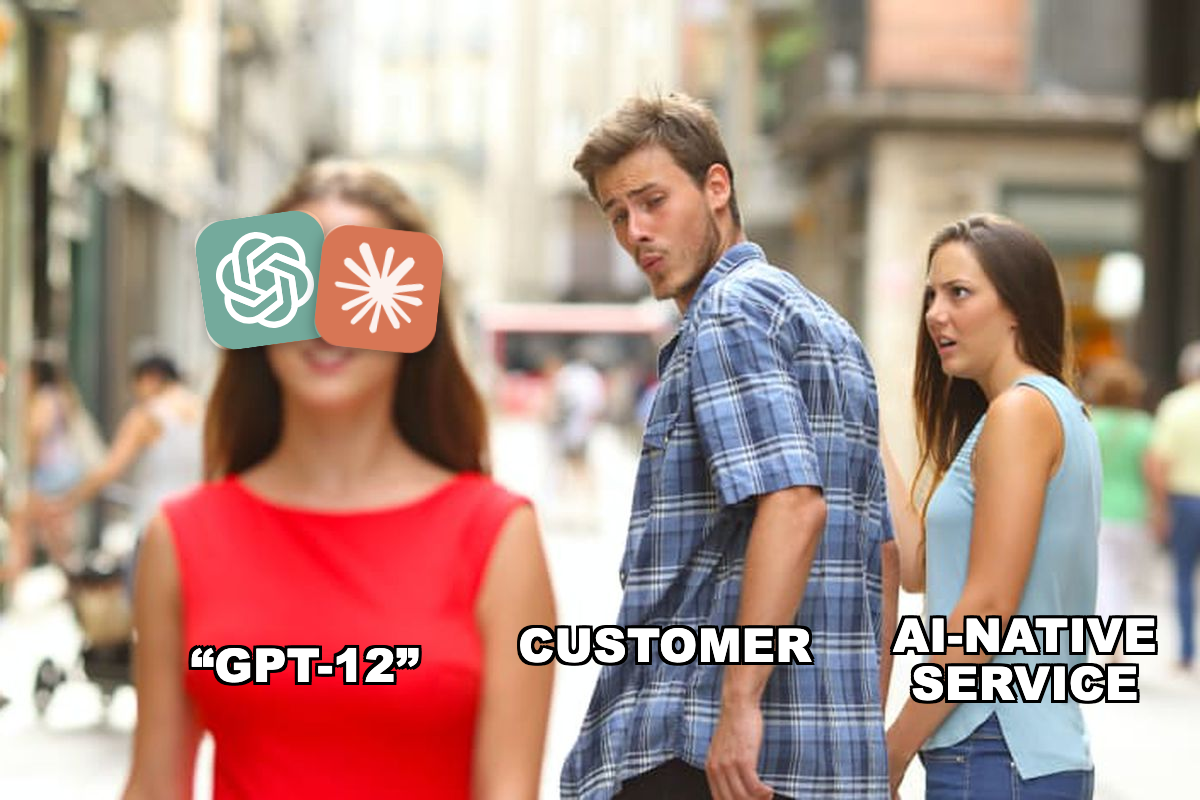
Every model generation closed a little more of the gap we were charging for, so the question inside the company was never if, only when: how long until a firm could get this quality straight from a foundation model? We called that future “GPT-12” - shorthand for the model that could do the whole job itself. Meanwhile, customers were getting more fluent with the tools every quarter. None of this was lost on EvenUp’s founders. The answer, fiercely debated inside the company, was to become part of how our customers worked - build more products that solved more of their recurring problems, including software, not just finished work, that lived inside their teams’ daily workflows. And we took on bigger, harder pieces of the customer’s problem, carrying more of the accountability. The demand letter product matured from the growth engine into one strong line among several. By then, the founders had turned the customer love, distribution, and market understanding of the head-start years into a durable, market-leading company - multiple thriving product lines across AI-native software and services. Every AI-native services firm is running the race we ran at EvenUp - stay ahead of the models long enough to turn a temporary edge into a permanent company. The rest of this post is about that race, and which side of it I’d rather own.
The arbitrage
In the first post I used Ronald Coase’s boundary of the firm to ask how AI changes which services companies will keep buying: which work goes in-house, which stays bought. The answer comes down to the mix of four things the customer is paying the professional services firm for: doing the work, checking the work, taking accountability for the outcome, and serving as an independent third party.1 That piece ended with a promise about the other half of the boundary - vendors winning work that had always lived inside the company, and the arbitrage that makes it a business.
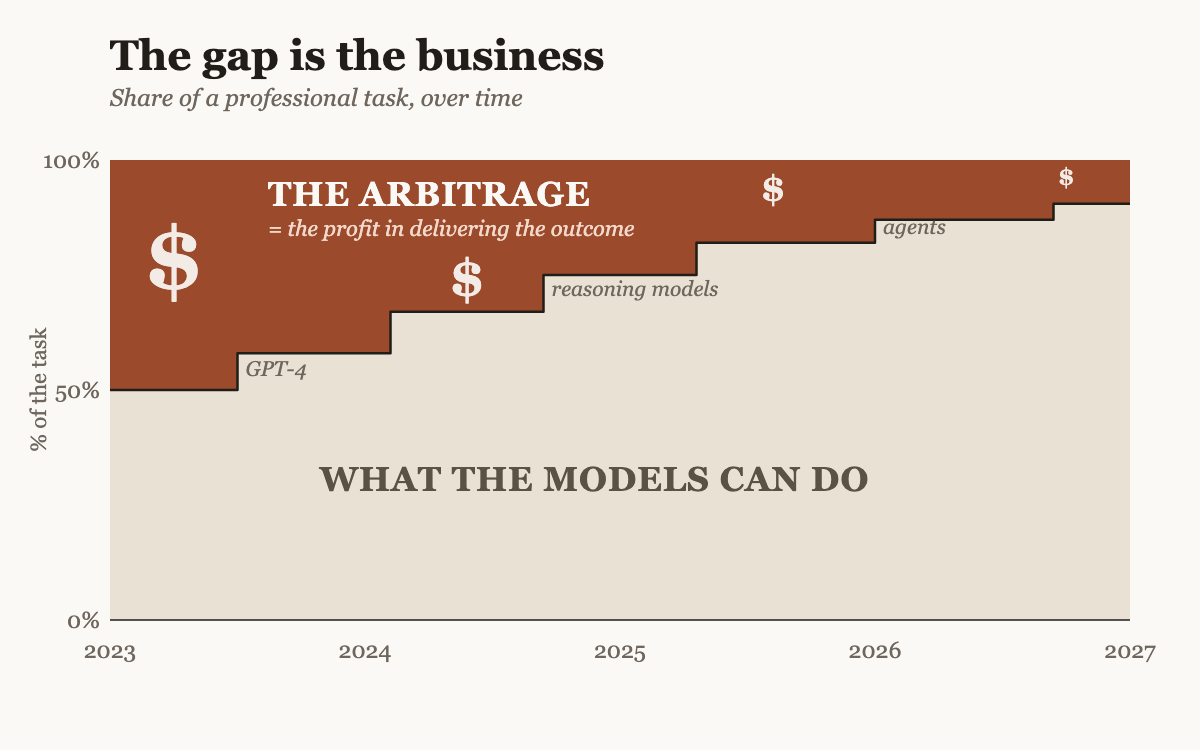
The arbitrage is basically a timing gap. The technology arrives for everyone, but not at the same speed on both sides of the boundary. The vendor who masters it first can deliver the work for a fraction of what the work costs the customer internally, charge yesterday’s price minus a discount, and pocket the difference for as long as the arbitrage holds. Everyone wins… for a while: the customer pays less than they used to, the vendor earns margins a traditional firm never could, and the market gets more efficient.
Two forces close the gap:
-
Model releases close it from below. The vendor’s advantage is hard-won at the current model’s jagged edge: the people, software, and tricks that deliver the last mile the model can’t. Every capability jump from the foundation labs risks making that value-add obsolete.
-
Customer fluency closes it from above. The tools keep spreading, and every quarter more customers get comfortable doing the work themselves with Claude or Codex - no vendor required.
The gap narrows gradually, and the early mover keeps the customer relationships even as their pricing power fades. To keep growing revenue and profit, you have to stay in the fat part of the arbitrage - and that means moving upstream, solving more critical problems for the customer, work they never imagined they could hand off. A bigger problem, taking on more accountability, and a higher willingness to pay.
A category is being built inside the arbitrage
Founders have noticed. AI-native services firms are launching in every vertical. Legal is the most crowded corner, where a new AI-native law firm seems to launch every week. Leave Big Law, buy one seat on Harvey, and you can call yourself an AI-native law firm.
Crosby, an AI-native law firm that raised a $60 million Series B this spring, reviews sales contracts in under an hour at a fixed price per document - and its pitch isn’t aimed at lawyers at all. It sells time to signature to sales teams at fast-growing startups, most of which don’t have a general counsel yet. General Legal publishes a price menu: $250 for a simple contract review, $500 standard, $1,000 for a negotiation - work that used to run through a fancy Silicon Valley firm at $1,000-plus an hour, now at an AI cost structure, priced well below what the incumbents charge. A third AI-native law firm pitches that its AI does 80% of the work, so you pay elite lawyers for only the final 20% - the arbitrage, quoted right on their homepage. It’s a fee with a countdown built in - when 80% becomes 90%, the billable remainder halves.
Meanwhile, the same work is going agentic inside companies. Ivo sells contract-review software to the in-house legal teams at Meta, Uber, and Atlassian, and claims it cuts a review from half an hour to under three minutes. Harvey and Legora sell to in-house teams too, not just to law firms. The entry-level work the AI-native firms are winning today - NDAs, routine commercial paper - is the work an in-house team is most likely to pull inside first: the most repetitive, the most bounded, and requiring the least judgment.
And AI-native software companies have discovered the same gap from their end - but they close it with code instead of people. The hottest go-to-market in enterprise AI right now is the forward-deployed engineer, or FDE - the Palantir playbook of embedding the vendor’s own engineers with the customer. Where an AI-native services firm puts people on the model’s jagged edge to review and fix its output, an FDE writes custom code that extends the vendor’s platform to solve that customer’s problem - and once built, it runs robustly and repeatably, without a human checking every output. Wonderful, founded in early 2025, reportedly rode this model from roughly $1 million to $70 million of ARR in a year, and just raised at a $5 billion valuation.
So within a single vertical you can watch both bets run side by side: the AI-native law firm, and AI-native software sold to law firms and their clients. Both are chasing the same prize - the trillion-dollar labor market that AI finally lets software address - just by different routes. I’m bullish on both, and I expect to partner with companies on both sides - especially services firms built in the terrain the first piece maps. But here’s why I believe the bigger, more durable opportunity ends up on the software side - four structural reasons.
The case for the software side
1) The widest amortizer wins the technology layer. Keeping an AI product current is a permanent engineering investment - and that doesn’t necessarily mean training your own models. It’s everything downstream of the labs: every new release means re-running your evals, rebuilding your agent harnesses, rethinking how the product handles context and memory, and redesigning the user experience around what the model can suddenly do - plus integrations, security reviews, compliance certifications, new features, new workflows. It never finishes. Funding a world-class engineering effort that never stops takes a particular kind of revenue, and this is where software and services split. The software vendor sells the technology itself, on contracts that recur - and recurring, committed revenue is what justifies pouring capital into R&D that ships to every customer at once. The services firm can have thousands of clients too, but its revenue arrives engagement by engagement, and a dollar of it is worth less for exactly that reason. You can’t underwrite a frontier engineering team on NDAs reviewed one at a time. So the technology layer ends up with whoever has a revenue model built to pay for it - and that’s the software company.
2) The software company is long model improvement. The services firm is short it. One side gains from every capability jump, the other loses. Each release hands the software vendor new capability that flows straight into its product and out to every customer. The very same release shrinks the capability gap the services firm’s margin lives inside. With models improving this fast, I’d rather be long.
3) The squeeze. The work an AI-native law firm can win today - high-volume, routine, specifiable - is exactly the work in-house teams armed with software pull inside first. The work that stays outsourced is where clients pay for accountability and independence, the two fees from Part 1 that don’t collapse. That means raising a round, an acquisition, a lawsuit, a sensitive employment matter, or the IP license a partnership hinges on. That work is defended by assets that take decades to build - the brand, the bench of partners who have seen it all, and a name nobody gets fired for hiring. A two-year-old firm has none of them yet. That’s the squeeze. On one side, in-house teams keep absorbing the routine work, through AI software or by working directly with the foundation models. On the other, the complex work stays with the traditional law firms that already have the assets it demands. The only way out is to push into Cravath and Goodwin’s territory.
4) Even the services firms end up buying the AI-native software. An AI-native law firm that builds its own technology runs straight into reason one - a software-scale R&D bill spread over a services-scale book of business. With Harvey, Legora, and the rest of the legal AI software companies pouring hundreds of millions into their platforms, does it make sense to spend your seed round rebuilding what they’ve already built (on one-hundredth of the budget)? The better economics usually come from being the platform’s power user - getting more out of it than any competitor - not a second builder of it. Put it together - work pulled in-house, work kept by incumbents, work won by AI-native firms - every path runs through the same software vendor. The services firm is a bet on where the boundary lands. The software vendor gets paid wherever it lands.
Does your category have its Legora yet?
If you’re the founder building an AI-native services company, one question sorts everything above: does your category have its winner yet? Not just a vendor selling AI-native software - every category will have vendors, and most of them will be mediocre - but a breakout at real scale, reaching escape velocity, the way Harvey and Legora have in legal.
If your category already has its winner, the four reasons above apply in full force. Draft off their R&D instead of rebuilding it, and know that your clients can buy the same tools you can. Spend your effort where the software companies aren’t - on the other bottlenecks in your industry’s workflow, the ones you can attack instead of reinventing the wheel. If no winner has emerged, the math flips. The arbitrage is fatter and lasts longer. A services firm in a claimed category is competing against the software and the models at once. In an empty one, it’s just the models. Plenty of categories still have no such vendor and run on people and decades-old systems - medical billing for small practices, insurance claims administration. In those categories, move fast. Build the AI-native services business and take share while the field is empty. Just make two judgments early:
-
Ask why the software doesn’t exist yet. Be careful with “these buyers just don’t buy software.” Owners buy whatever grows their profit, and anyone who shows up at their door with a product that credibly doubles it will get the meeting. Usually the real answer is that today’s product doesn’t deliver enough value to justify the disruption of adopting it. The surprise is that every new model release changes the ROI math for the buyer (more value, less change management). They don’t buy software… until they do.
-
Decide which company you’re actually building. A services firm that stays full-stack, or the category’s future software vendor - with the service as your evals, your training ground, and your distribution. The stack you build for your own delivery team is a head start on that product, not the product, and building as if you’ll externalize it is a day-one choice. How that jump actually works is its own story.
Where I’d still bet on the services side
The services bets that work share three traits:
-
Pricing decoupled from hours - the vendor keeps the efficiency gains instead of handing them back.
-
Buyers who want the easy button - limited appetite to run the tools or build their own. These are permanent buyers, not future builders.
-
A fee anchored in what doesn’t collapse - accountability and independence. This is the one that matters most, because it’s the defense against being pulled in-house.
EvenUp passed all three, and I’d argue it’s a big reason we grew as fast as we did. Personal-injury firms work on contingency, so our flat price was decoupled from hours from day one, and every dollar of delivery efficiency stayed with us. Our buyers wanted the easy button - lawyers who would rather practice law than run software. And we took accountability for the outcome - a finished letter, at or above the quality of their best paralegal.
Still, even the best-positioned arbitrage doesn’t last forever. While it holds, it pays twice - in profit, and in a free education in your industry’s biggest problems, learned live with real customers. But the fat part doesn’t stay put, and the mistake is investing as if it will. The winners convert those earnings into things no model release can take away: proprietary data, distribution, a trusted brand, sometimes the software itself.
You can see the shape in the wild. Reserv, an AI-native claims administrator founded in 2022 and backed by Bain Capital Ventures, runs claims end to end for insurers that will never build a claims department - licensed, accountable, paid per claim - and has already passed $100 million of revenue.
A trillion-dollar opportunity, up for grabs
The services economy is measured in the trillions of dollars, and for the first time ever, software can actually do the work - not assist it, do it. Almost all of that opportunity is still unclaimed, from either side: software that arms an industry, or an AI-native services firm that does the work for it. The revenue is out there. Somebody is going to take it.
If you’re already building in this space, or about to start, I’d love to hear what you’re building - and find a way to partner: andy@amity.vc.