"AI Eats Services" Is Half Right
July 15, 2026A 1937 paper explains which half.
“AI eats services” may be the most popular thesis in startups right now. Founders are building AI-native services firms in every category, and the biggest funds have planted flags on the wave, trillion-dollar TAM slides attached. Underneath it all sits the same argument: services spending is many times software spending, AI converts one into the other, the market is the org chart itself. The slide is right. It is also 89 years old.
Economics Nobel laureate Ronald Coase worked out the underlying law in 1937. It tells you which AI services bets are real, which are mirages, and why the difference has almost nothing to do with the models.
A note on scope: this piece is about AI and professional services, the work companies buy from other firms. Software replacing labor inside a company (your AI support agent, your AI SDR, your AI paralegal) is its own story, and a future post.
If you’re building an AI-native services firm and would rather skip straight to the conversation: andy@amity.vc. What I’m looking for is at the end.
Why should companies exist at all?
We all know why companies exist: to maximize shareholder value (obviously). Or, said less glibly: a company organizes people and capital around a need the market isn’t meeting.
Coase flipped the question: why shouldn’t companies exist? In the textbook world of pure market efficiency, with zero transaction costs, a company is unnecessary overhead. Every task would be a one-off transaction with the globally optimal counterparty: two hours of the world’s best contract negotiator, one deliverable from the perfect copywriter in Lisbon, month-end close run by a fractional CFO in Manila, each at a market-clearing price. No employees. No org chart. Just a mesh of perfect matches: individuals delivering professional services, anywhere in the world.
Companies are everywhere, so the textbook is missing something: transacting in the market is expensive.
- Search and information. What is a fair price, who are the credible providers, and is their work actually good?
- Bargaining and contracting. Negotiating terms for every unit of work, every time.
- Policing and enforcement. Verifying you got what you paid for, and carrying the fight when you didn’t.
Pay those costs on every transaction, for everything a business needs, and you would spend more time transacting than operating. Entire companies exist just to compress these frictions: Kelley Blue Book (price discovery), LinkedIn (credibility). eBay built the first great online marketplace on the full stack: pool the counterparties in one place, let ratings and guarantees absorb the policing, and charge a take rate for the privilege. A marketplace’s take rate is the price of these inefficiencies.
Coase’s insight, in “The Nature of the Firm” (1937): when hiring someone and directing them is cheaper than transacting for the work in the market, you hire. And once you’ve hired, you have a company. The same comparison draws each company’s edges. Every activity a business needs sits on one side of a line: done inside by employees, or bought outside (from a vendor, an agency, a professional services firm). The rational place for each activity is wherever it’s cheaper. Economists call that line the boundary of the firm. Add up thousands of those make-or-buy decisions and you get the size and shape of every company you’ve ever seen. Companies are shaped by friction. Change the friction, and the boundaries move.
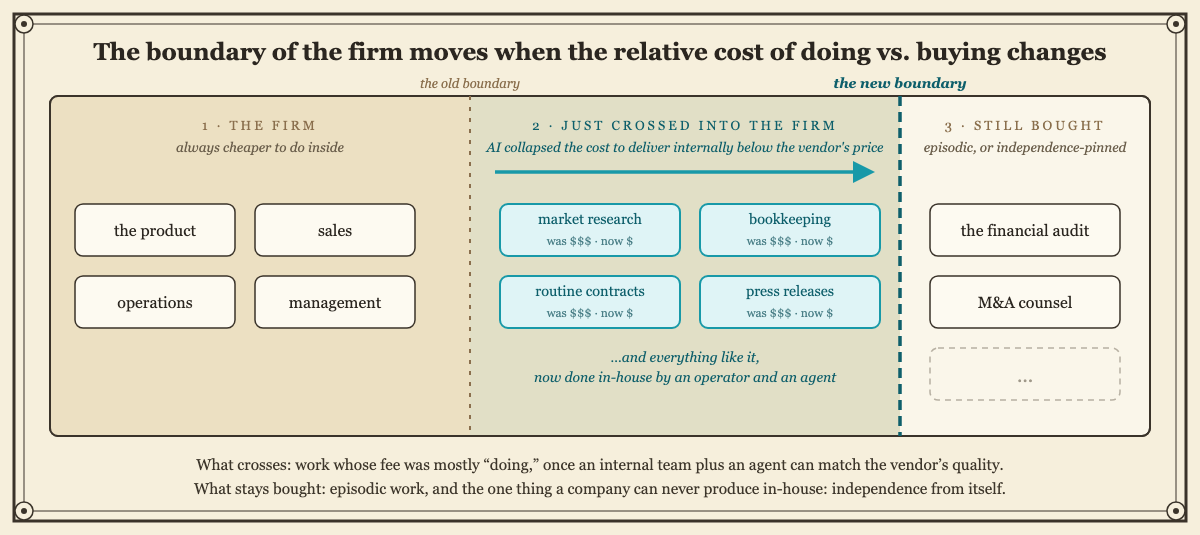
Technology is what changes the friction. As the communications technologies of Coase’s era became commonplace, the cost of running one company across many locations fell, and companies grew. In his words: “Changes like the telephone and the telegraph which tend to reduce the cost of organising spatially will tend to increase the size of the firm.” The decades since added the internet, then video conferencing, and now LLMs. The models do something none of the earlier technologies did: they don’t just carry information between the people doing the work, they produce the work itself. Same law, much bigger shock.
There is a catch, and Coase called it: most inventions change both costs at once, the cost of doing work inside and the cost of buying it outside. Which way the boundaries move depends on which cost falls faster.
The two battles
Run professional services through Coase’s lens, and the market splits into two battles.
The first battle is make-or-buy: does the client still need the professional services firm at all? LLMs cut the cost of delivering the work on both sides of the boundary, but they do something more specific: they deliver expertise, and in many cases expertise was the sole reason the work was bought rather than made. And Coase’s choice was always hire or transact. Now there is something new to hire: an AI agent, which takes direction like an employee and is paid in tokens instead of a salary and benefits. When a capable operator plus an agent produces output that clears the quality bar (even if it is worse than the specialist firm’s), the work moves inside. The pairing matters. The operator needs two things: enough knowledge of the business to spot the problem, and enough fluency with the tools to direct the agent. Software companies are full of people with both; a community bank may not have one. Companies without the operator keep buying, for now: the business knowledge was always inside, and every model release lowers the fluency bar. Spend that might have been hundreds of thousands or millions of dollars a year converts into a trivial token bill, paid directly to the model providers. No vendor wins this battle. The winners are the client, who keeps the money, and Anthropic and OpenAI, who collect the tokens.
This battle has a frequency filter: you hire for recurring needs and buy for occasional ones. Nobody stands up agents, workflows, and infrastructure for an integration that happens twice a decade. The outside firm runs that work every week, amortizes the build across every client, and stays the cheaper option. Recurring work moves inside. Episodic work stays bought.
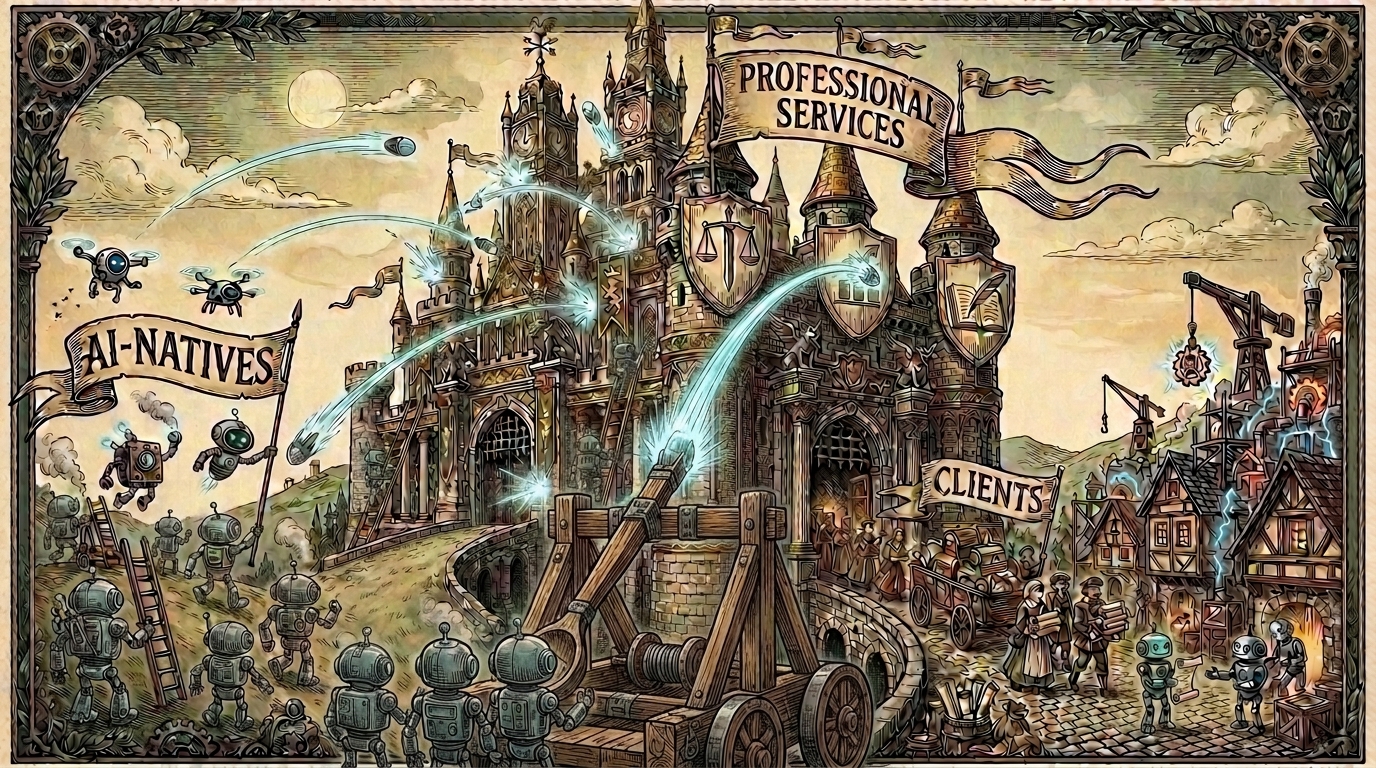
The second battle is over the pie that stays external: the incumbents against the AI-natives. This one runs across every professional services category: management consulting, legal, accounting, PR, recruiting, etc. The incumbents arrive holding exactly the assets that compress a buyer’s transaction costs: brand, reputation, credentials, decades of relationships, and genuinely excellent work product. But they are people businesses. The AI-native professional services firms rebuild delivery around agents with a thin layer of humans, which gives the two sides fundamentally different cost structures, and therefore different prices. This will not be winner-take-all; there is room for both. The real question is a race between two forces: AI-native pricing expands the market, pulling in buyers who could never afford professional services before, while in-housing shrinks it, as clients pull the most automatable work off the table entirely. Expect the incumbents to fight hard for share in the shrinking categories, the ones clients are learning to handle themselves, and to do what they have always done when a wave hits: move up into the next service line. There is already a booming market in AI transformation consulting.
One rule connects the battles: the firms are fighting over whatever the in-housing wave leaves behind. Whatever an AI-native services firm believes its market is, subtract the work clients are about to stop buying altogether.
Decompose the fee
So which professional services are safe? Which firms are selling work their clients are about to stop buying, and which will be resilient to the changing boundary of what companies in-house versus outsource?
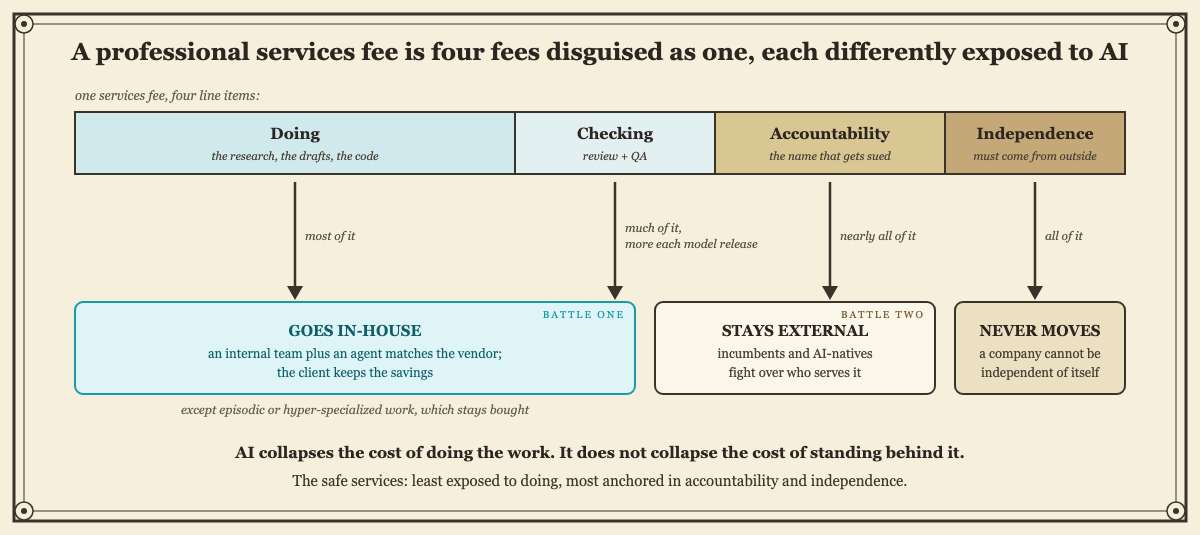
Any professional services invoice can really be broken down into four discrete line items that the customer never sees:
- Doing. Producing the work product: the research memo, the tax return, the campaign, the code, etc.
- Checking. Verifying the work is right: review layers, QA, partner sign-off.
- Accountability. Standing behind the work: the license, the insurance, the signature, the twenty-year relationship, the name that gets sued.
- Independence. Sometimes the product must come from someone who is not you: the audit opinion, the penetration test, the investigation of a senior executive, etc.
AI collapses doing fastest, which is why the most commoditized outsourcing is going first: offshore level-one support, fraud-review shops, the code mills that turn specs into boilerplate. Checking falls partially: AI can check AI, with loops and evals, but someone still has to check the checker and verify nothing was hallucinated. Accountability barely moves: a license, the firm’s malpractice insurance, and a long relationship are indifferent to the next model release. And independence never moves at all, because a company cannot be independent of itself.
So, the answer: the safe services are the ones least exposed to doing and most anchored in accountability and independence. The bigger the “doing” share of the fee, the faster the work goes in-house: the client’s team plus an LLM produces the output and keeps the savings. The more of the fee that is accountability, the longer the work stays external, where the second battle decides who serves it: the incumbent professional services firms, or the AI-native insurgents who underprice their way past a lack of reputation. And independence work never moves in-house, which produces the one exception to the doing rule: work that is almost pure doing can still be pinned outside the boundary when neutrality is the point. An agent can run the penetration test; only a third party can be believed about the result.
The walkthrough: law, accounting, code
Law. The doing is enormous; there is a reason Big Law associates work 80-hour weeks. But the industry is guarded by credentials and liability: you must pass the bar to practice, and clients go to outside counsel precisely for expertise, independence, and someone to hold accountable. So law splits by stakes. The routine work that never justified its billing rate, the contract review a client already resented paying junior-associate prices for, goes in-house and stops being legal spend at all: the first battle, already over for that work. The high-stakes work, the financing, the deal, the litigation, stays with credentialed lawyers, because what the client is buying there is accountability, not drafting. AI is all over that work too; it is just the lawyer holding it, through tools like Harvey or Legora, which is why the venture money in legal has mostly armed the incumbents rather than replaced them.
Accounting. The audit is the extreme case, where the product is the signature: only a licensed, independent CPA firm can issue an opinion, and a company cannot audit itself no matter how many accountants it employs. Audit fees and headcount will compress; the category will not move. Bookkeeping is the opposite case: no license, thin judgment, almost all doing, and therefore wide open.
Outsourced software development. The purest case: the doing is code, and code is where the models are strongest. Nobody hires an offshore dev shop for its signature. No license, no privileged relationship, and the deliverable is machine-checkable. This work moves first and most completely, and much of it doesn’t move to a better vendor. It moves in-house, to an experienced developer and a $200-a-month model subscription.
Four questions for any AI-native services pitch
All four are versions of one question: which side of the boundary will this work sit on in five years?
- Decompose the fee. What fraction of what the customer pays is doing versus checking versus accountability versus independence? The doing share is the share the boundary is about to swallow.
- Is the signature regulated? If a license, ownership rule, or independence requirement guards the work, the boundary cannot move. The entrant must become the institution, partner with it, or sell to it.
- Is the need recurring or episodic? Recurring needs are the ones clients eventually staff and automate in-house. Episodic work stays bought, because the vendor runs it every week and amortizes the build across every client.
- When they lose a customer, why? Switched to a competitor: that is the second battle, compete harder. Stopped buying the category: the boundary itself moved, and no roadmap moves it back.
How I think this plays out
So where does the boundary between companies and their professional services firms settle? Three calls.
1. The top of the market is close to impenetrable. McKinsey, the Big Four, and the Goodwins of the world were never bought on price, and they will not be lost on price. Those clients are paying for safety, independence, and a name that survives a board challenge. The technology is buyable; trust is not. What changes is the shape of the engagement: the doing-heavy layers, the market studies, the survey work, the rinse-and-repeat analysis, fall away, and what the top firms sell tilts even more toward high-level strategy and the judgment work where accountability matters most.
2. The AI-natives grow the market from the bottom. Their real opening is demand the incumbents never served: buyers for whom accountability at $200,000 was unthinkable but at $20,000 clears easily, a product that only exists once the doing underneath costs nearly nothing. They will also catch the doing-heavy work falling out of the top-of-market engagements, work that landed at brand-name prices only because there was nowhere else credible to send it, and never belonged at the top of the market to begin with.
3. In an unprotected category, enterprise revenue disappears first. Enterprise clients have the teams and the appetite to bring work in-house. The ice cream shop will pay someone to do its taxes forever; there is nobody behind the counter to in-house them. For once, the SMB book may be the durable one.
AI collapses the cost of doing the work. It does not collapse the cost of standing behind it. That gap is where every AI services bet lives, and Coase drew the map for it 89 years ago.
What I’m looking for
An AI-native services firm selling doing-heavy work to enterprise clients is racing the boundary, no matter how fast the logos are stacking up. Over time, the boundary catches up.
The firms I want to meet are built the other way. Agents do the doing, and the fee is anchored in something the client cannot, or will not, produce in-house: the signature, the license, the liability, the neutrality.
If you are building an AI-native services firm that resembles this, one that can meaningfully turn a $200,000 service into a $20,000 one, I want to hear from you.
Next post: the other half of the boundary. Vendors absorbing the work companies used to do inside, and the arbitrage window that makes it a business.